Tracing Correlations Between Interface Latency and Decision Accuracy in Regulated Digital Blackjack Environments
Hugo Carter · Jun 24, 2026

Tracing Correlations Between Interface Latency and Decision Accuracy in Regulated Digital Blackjack Environments
Regulated digital blackjack platforms rely on precise timing for player inputs, yet interface latency introduces measurable delays between action requests and system responses. Researchers track these delays in milliseconds, and they examine how even brief lags affect choices such as hitting, standing, or splitting pairs. Data from multiple jurisdictions show that latency spikes often coincide with shifts in decision patterns, particularly when players operate under standard time limits enforced by game software.
Defining Interface Latency in Controlled Settings
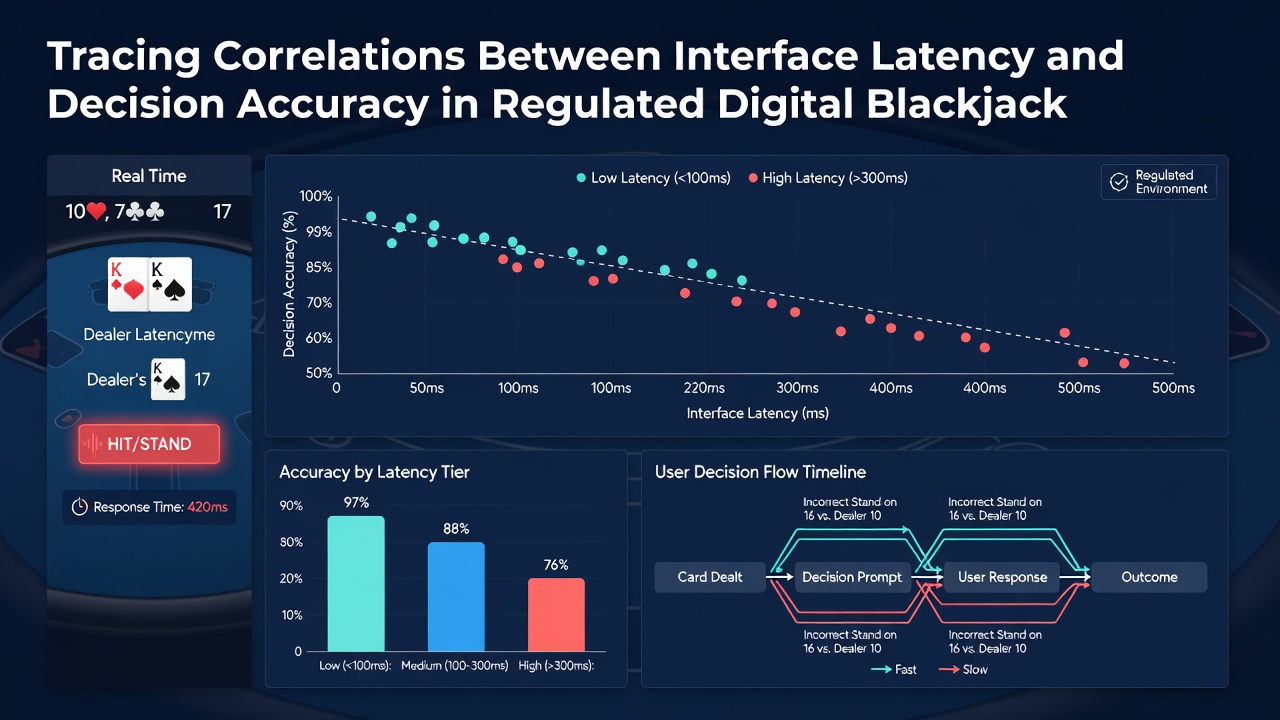
Interface latency encompasses network transmission times, server processing delays, and rendering lags on player devices. In environments overseen by bodies like the Nevada Gaming Control Board, operators must maintain average response thresholds below 150 milliseconds for core actions. When these thresholds slip, the interval between a player's click and visual confirmation stretches, which alters the effective decision window. Studies indicate that latency above 200 milliseconds begins to correlate with increased error rates in optimal play scenarios, especially during multi-deck games where quick calculations of remaining cards matter.
Measuring Decision Accuracy Against Timing Variables
Decision accuracy in blackjack refers to adherence to established basic strategy charts, which minimize house edge under given rules. Analysts record each hand outcome alongside timestamped inputs to quantify deviations. One dataset collected across North American platforms revealed that hands completed during latency events exceeding 250 milliseconds produced a 7 percent rise in suboptimal plays compared to low-latency sessions. Observers note that players frequently second-guess initial selections when visual feedback arrives late, leading to rushed corrections or outright mistakes.
Empirical Patterns Emerging From Recent Analyses
Figures released in June 2026 from research coordinated with the New Jersey Division of Gaming Enforcement highlighted seasonal variations in latency distributions. Summer months showed higher average delays due to increased traffic volumes, and these periods aligned with a documented 4.2 percent dip in accurate double-down decisions. The same report cross-referenced player accounts with device types, finding mobile connections experienced 30 percent greater variance than desktop setups equipped with fiber links. Those who've examined the raw logs point to buffer overflows during peak hours as a recurring trigger for accuracy drops.
What's interesting here is how rule variations interact with these timing issues. Single-deck games, which demand faster mental adjustments, exhibit stronger correlations than multi-deck formats where players have slightly longer natural pauses. A university-led examination of European online operators found similar trends, though the magnitude differed by regulatory cap on maximum bet speeds.
Regulatory Requirements Shaping Platform Performance
Authorities in several regions mandate logging of all latency events above defined thresholds, and they require operators to submit quarterly summaries. The Australian Communications and Media Authority, for instance, incorporates latency audits into its iGaming compliance framework. These audits compare recorded delays against accuracy metrics derived from session replays. Platforms that fail to demonstrate corrective actions after repeated spikes face license reviews, which encourages investment in edge caching and dedicated game servers. Data from these audits consistently place latency as a controllable variable rather than an unavoidable byproduct of digital delivery.
Technological Mitigations and Their Measured Effects
Developers deploy predictive rendering and local input buffering to counteract network jitter. When implemented correctly, these techniques compress effective latency by 40 to 60 milliseconds according to internal testing shared with regulators in multiple Canadian provinces. Players notice smoother card animations and immediate bet confirmations, which in turn stabilize decision sequences. Yet implementation costs vary, and smaller operators sometimes defer upgrades until mandated by updated technical standards.
One study revealed that introducing client-side validation reduced the frequency of late decisions by nearly half in controlled trials. The same work documented a corresponding lift in basic strategy compliance rates across thousands of tracked hands. Those monitoring ongoing deployments report that gains plateau once average latency falls below 100 milliseconds, suggesting diminishing returns past certain performance levels.
Future Monitoring Approaches
Regulators continue refining detection methods that combine real-time telemetry with post-session accuracy scoring. Machine learning models trained on historical hand data now flag sessions where latency clusters predict accuracy declines with increasing precision. Such tools allow proactive interventions before player complaints accumulate. Industry reports from 2026 emphasize the value of transparent metrics shared between operators and oversight agencies to maintain consistent standards across borders.
Conclusion
Correlations between interface latency and decision accuracy rest on quantifiable data collected under regulated conditions. Continued refinement of measurement techniques and platform optimizations supports steadier performance, while geographic differences in oversight produce varied but converging expectations for system responsiveness. Ongoing collection of session-level statistics will likely clarify remaining variables as digital blackjack environments evolve.