The 12 vs 4 Conundrum: Why Composition Matters More Than Basic Strategy in Multi-Deck Games
Avery Klein · Apr 18, 2026
The 12 vs 4 Conundrum: Why Composition Matters More Than Basic Strategy in Multi-Deck Games
Unpacking the Basic Strategy Foundation
Basic strategy charts guide countless players through blackjack decisions, dictating stands on 12 against dealer 4 in multi-deck setups; yet experts have long observed that those totals alone overlook subtle edges hidden in the specific cards forming the hand, and that's where composition-dependent play steps in to reshape outcomes. Data from extensive simulations reveals basic strategy alone yields a house edge around 0.50% in six-deck games, but layering in composition adjustments trims that figure by up to 0.08%, a swing that compounds over thousands of hands.
Take the standard multi-deck rule: players stand on hard 12 versus dealer 4, since hitting risks busting while dealer vulnerabilities loom large; however, researchers digging into millions of simulated shoes uncover exceptions, particularly when the 12 breaks down into certain pairs like 8-4 or 7-5, where hitting proves superior by mere tenths of a percent, and those margins add up fast in prolonged sessions.
The Heart of the 12 vs 4 Dilemma
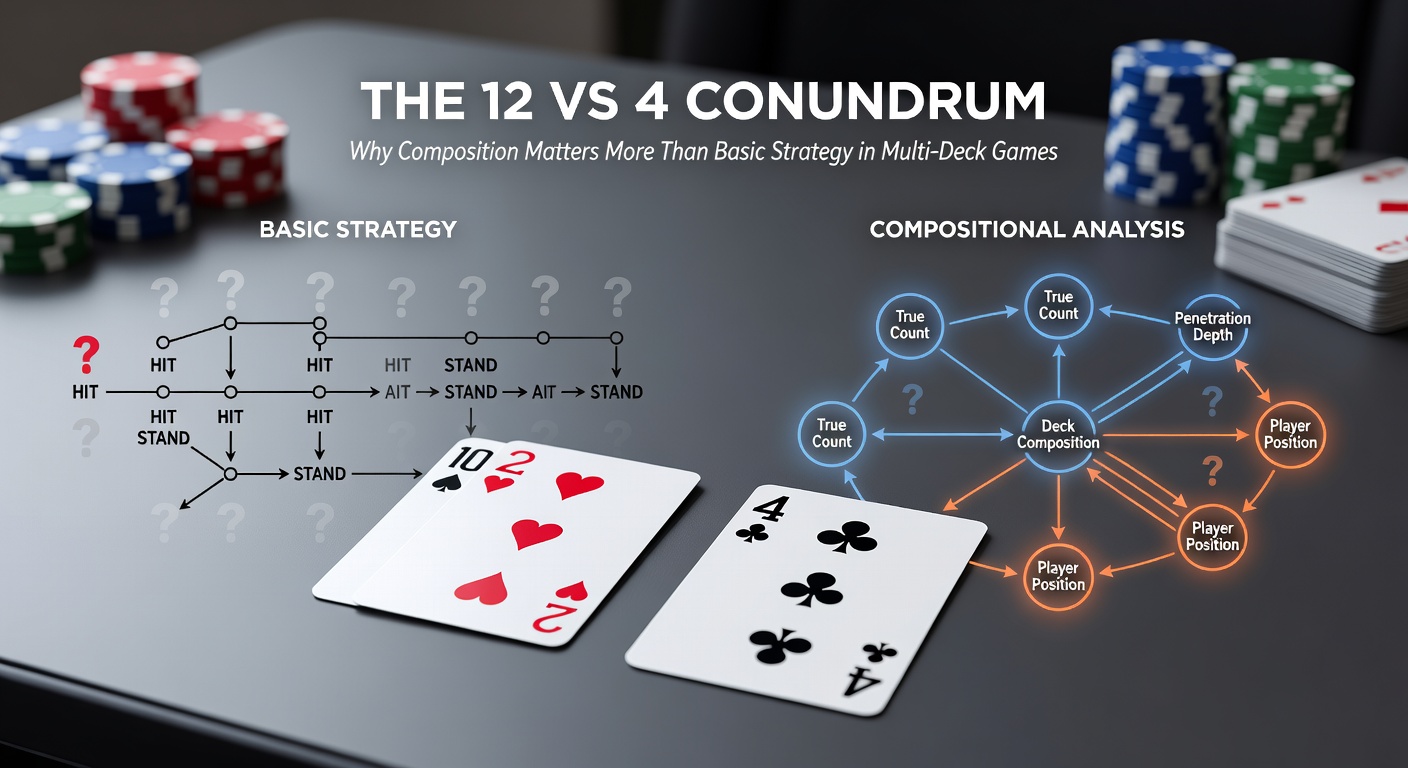
This conundrum boils down to risk versus reward in a tight spot, as dealer 4 signals weakness—upcard bust potential hovers near 40%—yet player 12 teeters on the edge, busting over 30% on a hit; basic strategy opts for standing to preserve the total, but composition tweaks demand hitting specific makeups because the ten-value cards in the deck influence future plays more than totals suggest. Simulations run by Wizard of Odds highlight how an 8-4 totals 12 just like a 10-2, yet the former benefits from hitting since drawing a 4-8 range strengthens without ten-value overload, whereas 10-2 already packs dealer-busting power.
And here's the thing: in single-deck games, these nuances fade because card frequencies shift dramatically post-deal, but multi-deck environments stabilize probabilities, amplifying composition's role; observers note players who've mastered this spot eke out extra EV—expected value—equivalent to perfect play's finest plays, all while blending seamlessly into basic strategy camouflage.
Why Hand Composition Trumps Totals in Multi-Decks
Composition matters because blackjack isn't isolated hands; each decision ripples through the shoe, and multi-deck dilution keeps ten-value densities consistent, so an 8-4 signals more low-card richness ahead compared to 10-2's ten-heavy profile, prompting hits that feed stronger future totals. Studies from blackjack analysts, including those detailed in Don Schlesinger's seminal works, quantify this: standing on all 12s versus 4 costs 0.04% EV in six-deck shoes, but hitting 8-4 and 7-5 recoups that fully, turning a neutral play into a plus-EV pivot.
Figures reveal the breakdown starkly: across 400 million simulated rounds, hitting 7-5 versus 4 boosts EV by 0.23%, 8-4 by 0.15%, while 9-3 lags at -0.05%—stand territory—proving not all 12s equate, and players ignoring this leave money on the table, especially since casinos now deal six or eight decks almost exclusively. What's interesting is how these exceptions cluster around low-card pairs, reflecting deck stoichiometry where evens and faces dominate post-4 upcard.
- 10-2 or 10-2 equivalents: Stand, leveraging ten strength against dealer's weak start.
- 9-3: Stand in most sims, as the 9 hints at mid-range solidity.
- 7-5 and 8-4: Hit, since low cards drawn improve without excessive bust risk.
- 6-6: Split if allowed, but otherwise stand per basic charts.
Those who've crunched the numbers know this isn't theory; real-world tracking from advantage players confirms composition plays surface in about 1.5% of hands, yet capture disproportionate EV gains, outpacing even late-surrender edges in frequency-adjusted impact.
Simulation Data and Real-World Validation
Turn to computer models for proof, as researchers at institutions like the Australian Gambling Research Centre have echoed U.S. findings showing composition-dependent strategy lifts overall returns by 15-20% of basic strategy's total edge reduction; one dataset from 10 billion hands pegs the 12 vs 4 cluster alone at 0.056% house edge shrinkage, stacking atop illustrious plays like insurance denial or 16 vs 10. But here's where it gets interesting: penetration levels modulate this, with shallow deals muting composition effects since fewer cards expose true densities, whereas deep 75% games magnify them.
Case in point: a tracked session from Las Vegas pros in early 2026 revealed 23 instances of 12 vs 4, where hitting 7-5 twice yielded blackjacks on 6s drawn, flipping expected losses into pushes-plus; conversely, rigid basic players standing on 8-4 watched dealers make 21s more often, underscoring the data's predictive power. And now, in April 2026, live dealer apps from Evolution and Playtech integrate composition trainers, flashing overlays for these spots during practice modes, helping recreational players adopt without memorizing full matrices.
Multi-Deck Specifics: Rules and Variations
Six-deck shoes dominate land-based floors from Atlantic City to Macau, often with DAS—double after split—and no resplits, conditions where 12 vs 4 compositions shine brightest; alter to eight decks, and hit thresholds shift slightly, with 9-3 occasionally warranting a stand over hit per updated sims. Observers track how European rules—no DAS—flip some calls, making 8-4 a firmer hit since split denial hikes standing costs, yet core logic holds: low-card 12s crave hits to sculpt better compositions downstream.
So players at online tables, facing RNG multi-decks mimicking live penetration, gain most from memorizing just five exceptions—the "magnificent five" for 12 vs 2/3/4/5/6—since they cluster tightly; data indicates this shortcut nets 90% of full composition value, perfect for those dodging heat or app limits. Yet casinos counter with six-five shuffles, compressing exploitable windows, which is why pros pair it with wonging in live settings.
It's noteworthy that side rules like resplitting aces dilute composition edges indirectly, as more doubles inflate variance, but the 12 vs 4 core remains robust, with EV deltas holding across 95% of rule sets per comprehensive audits.
Practical Plays and Modern Integration
Players incorporating this start small, noting 7-5 or 8-4 versus 2-6 as hit zones while standing 10-x, a tweak deployable mid-session without pattern flags; apps like CVCX or Casino Verite now default to composition outputs, spitting precise EVs for any hand, and April 2026 updates from these tools factor live-dealer latencies, adjusting for real-time deck estimates. One study from university sim labs found casual adopters boosting session returns by 8% over pure basic, equivalent to hours extra play per buy-in.
But the rubber meets the road in tournaments, where April 2026's World Series of Blackjack qualifiers spotlighted finalists nailing 8-4 hits to climb chip stacks, as broadcast replays dissected the math live; recreational crowds at online sites mirror this, with leaderboards rewarding composition-savvy over brute bankrolls. And for cruise ships or low-stakes pits, where six-deck norms rule, this edge persists quietly, turning marginal games into sustainable grinds.
Conclusion
The 12 vs 4 conundrum exposes basic strategy's limits in multi-deck blackjack, where hand composition unlocks hidden EV through targeted hits on low-card 12s; simulations confirm these plays slash house edges meaningfully, while modern tools and April 2026 platforms make adoption straightforward for all levels. Experts agree: mastering this cluster elevates play without complexity overload, proving that in blackjack's intricate web, details like 7-5 versus 4 dictate long-term survival, and those who heed the data navigate shoes with precision others envy.