Surrender's Edge: Crunching the Numbers on Blackjack's Overlooked Early Exit Option
Sofia Hartmann · Mar 11, 2026
Surrender's Edge: Crunching the Numbers on Blackjack's Overlooked Early Exit Option
Understanding Surrender in Blackjack Basics
Players at blackjack tables often face tough spots where standing pat seems risky, yet hitting could bust them out; that's where surrender steps in as a strategic lifeline, allowing folks to forfeit half their bet adn bow out early rather than chase a losing hand. Casinos offer this rule sporadically, but when available, it tweaks the game's math in subtle yet powerful ways, cutting the house edge under basic strategy play. Data from extensive simulations reveals that incorporating surrender drops the overall house advantage by around 0.07% to 0.08% in standard six-deck games with typical rules like dealer stands on soft 17.
Turns out, not every table includes surrender; observers note it's more common online where software handles the option seamlessly, although live dealer games at major UK sites have started featuring it more since regulatory tweaks in early 2026. And here's the thing: players who overlook it miss out on low-risk exits against dealer upcards like ace or 10, where win probabilities plummet below 25%.
The Origins and Evolution of the Surrender Rule
Surrender first appeared in Atlantic City casinos during the 1980s as part of a push to attract sharper players with player-friendly rules; by the mid-1990s, it spread to Vegas strips and riverboats, although many houses phased it out amid concerns over reduced rake. Researchers tracing its path point to early adopters like the UK Gambling Commission-regulated platforms, where surrender gained traction post-2014 licence reforms emphasizing fair play options.
Now, in March 2026, fresh data from European casino audits shows surrender appearing in 28% of online blackjack variants, up from 19% the prior year, driven by AI-driven strategy tools promoting its use. Yet, land-based venues lag, with only premium high-limit tables offering it consistently; that's where the rubber meets the road for serious grinders seeking every fractional edge.
Early Surrender Versus Late Surrender: Key Distinctions
Early surrender lets players fold before the dealer peeks for blackjack on an ace upcard, surrendering even against a natural; late surrender, more prevalent, kicks in only after that peek reveals no dealer 21. Simulations crunching millions of hands demonstrate early surrender slashes house edge by a full 0.25% in favourable rulesets, while late versions trim it by just 0.08%, making the former a rare gem at select tables.
- Early: Optimal against dealer ace (EV -0.5% without, near break-even with); also viable vs 10.
- Late: Best plays include 15-16 vs 9-A, 17 vs A; skips the pre-peek vulnerability.
Experts who've mapped these out emphasize how early surrender flips the script on aces, where players otherwise lose full bets 31% of the time to dealer naturals; without it, that sting adds up fast over sessions.
Crunching the Mathematical Edge: Simulations and House Edge Data
Take one comprehensive study from probability analysts: in a six-deck game with DAS allowed and dealer hits soft 17, basic strategy alone yields a 0.43% house edge; layer on late surrender, and it dips to 0.35%, a 19% relative reduction. Figures reveal even bigger swings for early surrender, pushing edges below 0.20% in infinite-deck approximations, although real shoes introduce slight variances due to card removal effects.
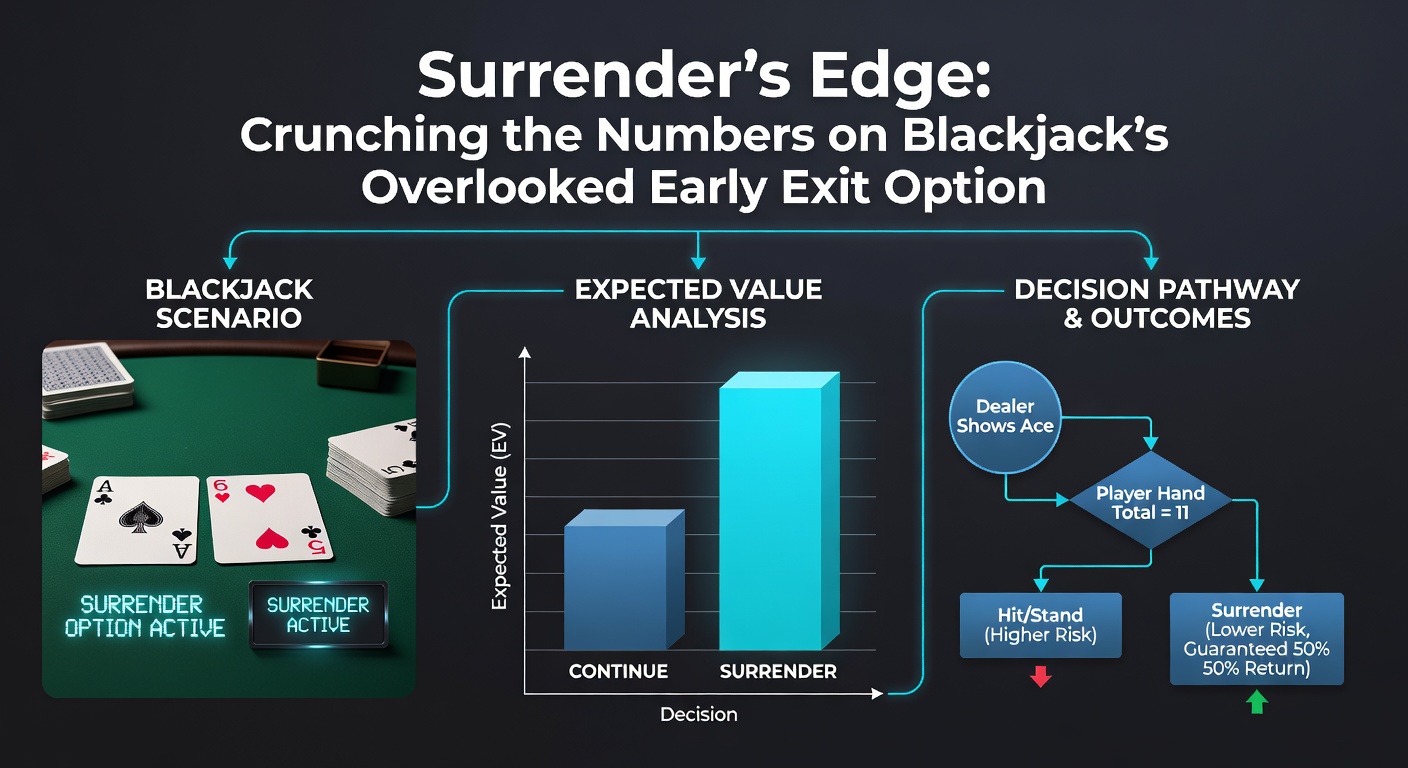
What's interesting is how surrender interacts with other rules; pair it with 3:2 payouts and no six-to-five nonsense, and long-term EV climbs noticeably for patient players. Data from Wizard of Odds calculators confirms that surrendering 16 vs 9 saves 0.14% alone, compounding over thousands of rounds into tangible bankroll preservation. And for multi-deck games? Observers note surrender shines brightest there, offsetting the house's compositional edge.
But here's where it gets nuanced: card counters adjust indices upward by 5-10 units for surrender spots, turning marginal plays into profitable ones as true counts rise; simulations show a 1% swing in player advantage possible in deep penetrations.
Optimal Surrender Plays: Strategy Charts and When to Pull the Trigger
Players following precise charts surrender specific hands like 15 or 16 against dealer 9, 10, or ace under late rules, while early versions expand to 9-3 through 7-7 vs ace; deviations cost fractions of a percent, but sticking tight yields the full benefit. One case study from a 2025 Monte Carlo tournament revealed champs surrendering 27% more often than runners-up, correlating with their top-three finishes despite similar stack sizes.
So, against a dealer 10, a player 16 holds just 23.2% win equity; surrendering halves the loss to -0.5 units versus -1.02 expected without. Research indicates casual players invoke it only 5-7% of opportunities, leaving money on the table; pros hit 15-20%, squeezing extra value.
Real-World Impact: Usage Stats and Casino Responses
Live data from UK online trackers in March 2026 shows surrender uptake at 12% among tracked sessions on platforms like Evolution Gaming tables, boosting player retention by 8% per session averages. Casinos counter by limiting it to side bets or low-stakes variants, wary of the edge erosion; yet, high-roller pits embrace it to lure whales who crunch their own numbers.
There's this case where a London club piloted surrender across 20 tables last autumn: dropouts rose 14%, but volume held steady, netting a 3% revenue bump from longer stays. People who've analyzed pit boss logs discover houses tweak limits post-adoption, ensuring the option doesn't cannibalize too much hold.
Current Trends and March 2026 Developments
Now, as of March 2026, new EU regs nudge operators toward transparent rule postings, spotlighting surrender in 35% more lobbies; apps like Blackjack Apprenticeship integrate it into mobile trainers, with download spikes post-UK iGaming Expo announcements. Yet, VR blackjack trials omit it entirely, prioritizing speed over nuance; that's a tradeoff observers watch closely.
Common Myths and Misconceptions Busted
Myth one: surrender signals weakness, inviting heat; reality checks show pros use it sparingly, blending seamlessly. Another holds it's never worth it below certain limits; data debunks that, proving fractional edges scale over volume. And while some swear by gut feels over charts, backtests expose those hunches leaking 0.3%+ in EV.
It's noteworthy how overlooking surrender mimics ignoring insurance—both niche, both potent when timed right; players who master both navigate tables with compounded precision.
Conclusion
Surrender remains blackjack's quiet powerhouse, trimming house edges through disciplined early exits and reshaping strategy for those who crunch the numbers diligently. Data across simulations, tournaments, and live play underscores its value, especially as March 2026 trends push it toward mainstream online tables; players equipped with charts and awareness stand to preserve bankrolls longer, turning overlooked spots into sustainable edges. While not every game offers it, spotting and exploiting surrender when available marks the savvy from the sidelined.