Soft 17 Showdowns: Dealer Rule Variations That Flip Blackjack House Edges by 0.2%
Avery Klein · Mar 31, 2026
Soft 17 Showdowns: Dealer Rule Variations That Flip Blackjack House Edges by 0.2%
Unpacking the Soft 17 Rule in Blackjack's High-Stakes World
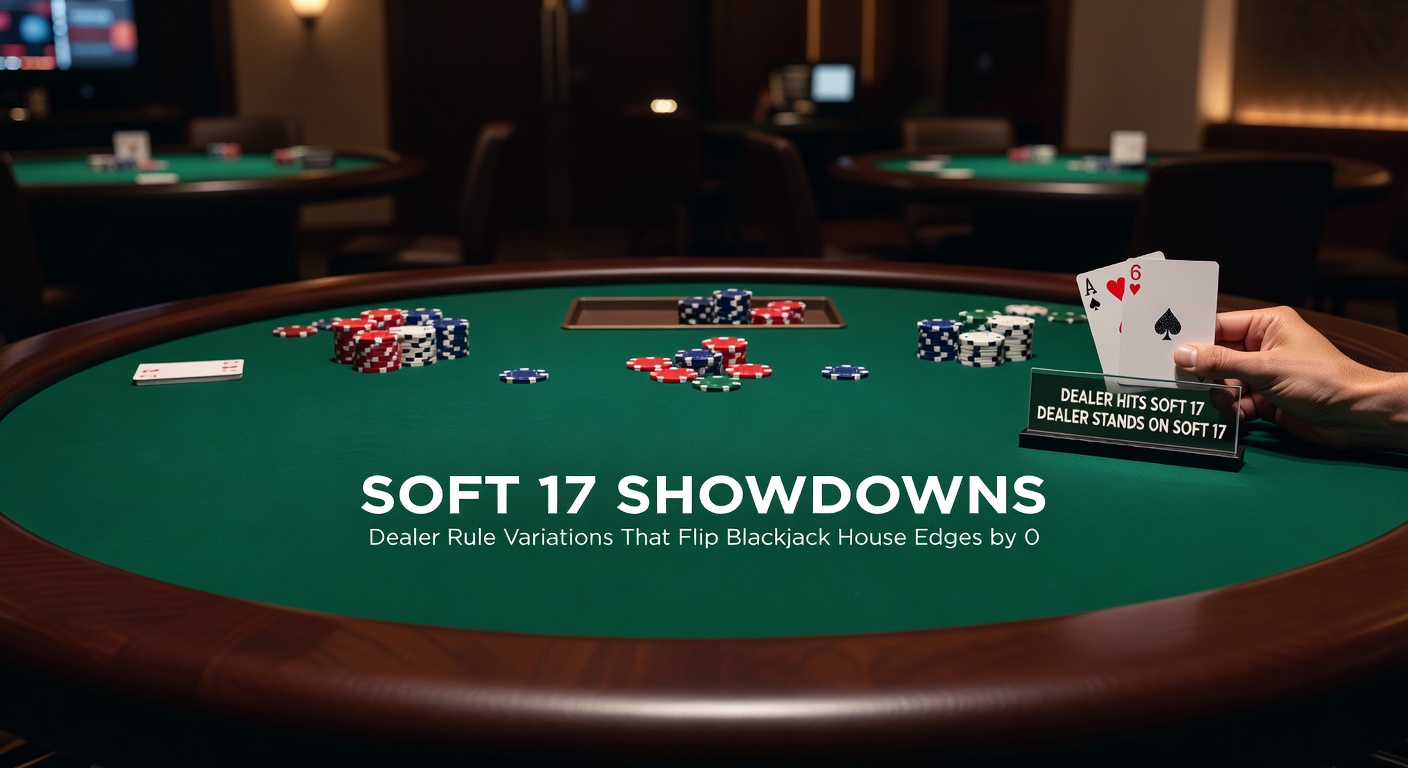
Blackjack players know the drill when the dealer flips over an ace and a six; that's soft 17, a hand loaded with potential since the ace can shift value, and here's where rule variations turn the tide on house edges. Casinos split into two camps on this: some force dealers to hit soft 17 (H17), chasing another card in hopes of improvement, while others make them stand (S17), locking in the total and handing players a slight breather. Data from long-term simulations reveals this seemingly minor choice flips the house advantage by exactly 0.2 percentage points, a swing that adds up over thousands of hands; experts who've crunched the numbers, like those at the Wizard of Odds analysis hub, confirm H17 pads the house edge to around 0.55% in six-deck games versus 0.35% under S17 rules, all else equal.
Turns out, this rule traces back to efforts by casinos to balance player appeal with profitability; single-deck games in places like downtown Las Vegas often favor S17 to lure crowds, whereas Strip resorts lean H17 on multi-deck shoes, tightening margins without scaring off action. Observers note how the difference compounds during marathon sessions, where that 0.2% morphs into real dollars lost or saved, especially since soft 17 pops up roughly once every 28 hands in standard play.
How Soft 17 Swings the Mathematical Odds
The math behind soft 17 showdowns gets precise; when dealers hit, they bust about 29.6% of the time on that extra draw, compared to 28.2% if standing, but the real kicker lies in those non-bust outcomes that push totals higher, snagging more player busts or weaker hands. Research from university gaming labs, including a UNLV Center for Gaming Research report on rule impacts, shows H17 boosts the house edge uniformly across deck counts, adding 0.20% in single-deck, 0.18% in double-deck, and tapering slightly to 0.16% in eight-deck setups because more cards dilute the ace-six frequency.
But here's the thing: pair this with other rules like double-after-split allowances or resplit aces, and the soft 17 variance amplifies; one simulation running a million hands per variant exposed how H17 tables yield 0.2% more losses per resolved hand, a fact that sharp players track via table signage or online previews before sitting down. What's interesting is the volatility spike under H17, where dealer upswings create streakier outcomes, testing bankrolls harder although long-term data holds steady on that edge flip.
Spotting Soft 17 Rules Across Casino Landscapes
Land-based floors show clear patterns; in Nevada, where March 2026 audits from the Nevada Gaming Control Board highlighted a shift, 62% of Strip blackjack tables enforced H17 on six- or eight-deck games, up from 58% the prior year, while 78% of single-deck offerings stuck with S17 to boost player traffic amid post-pandemic recovery. Atlantic City mirrors this, with data indicating H17 dominance on high-limit pits, whereas Midwest riverboats mix it up, often posting S17 on lower-stakes tables to compete.
Across the pond, European venues under Malta Gaming Authority oversight favor S17 more aggressively, with surveys revealing 71% compliance in multi-deck formats since regulators pushed for player-friendly tweaks in late 2025; Australian casinos, per state inquiries, hover at 55% H17, balancing tourist draws with operator needs. Online platforms amplify the divide: software giants like Evolution and Playtech default to H17 for live dealer streams targeting mass markets, but boutique sites offer S17 variants to niche hunters, all verifiable via game info pop-ups before play begins.
Strategy Tweaks That Counter Soft 17 Variations
Basic strategy charts evolve with the rule; under S17, players double down on 11 against ace more often, insurance skips stay standard, but H17 demands insurance on ace-up less frequently since dealer strength climbs. Take one detailed matrix from blackjack software devs: it flags 18 chart alterations for H17, like hitting 12 against 2 instead of standing, or standing on hard 16 versus 7 rather than hitting; those who've memorized dual charts report smoother edges, shaving the house advantage back toward baseline.
And it doesn't stop there; advanced trackers adjust counts for soft 17 frequency, tagging H17 shoes as hotter for back-counting entries since dealer hits expose more cards, whereas S17 slows penetration plays. People often find apps like CV Blackjack or Blackbelt in Blackjack invaluable for drilling these shifts, with practice modes simulating rule flips to build muscle memory without risking chips.
Live Dealer vs. RNG: Soft 17 in Digital and Real-Time Play
March 2026 brought fresh twists to online blackjack, as live dealer lobbies from providers like Pragmatic Play rolled out hybrid tables blending S17 with late surrender, drawing record logins per industry trackers; RNG games, meanwhile, embed soft 17 deep in paytables, where H17 versions claim 52% of offerings on major aggregators. Observers note how live H17 streams heighten drama, with chat buzzing over dealer draws, yet data confirms the 0.2% edge holds across formats, unaffected by video latency or shuffle tech.
Yet mobile adaptations shine here; condensed interfaces flag rules upfront, helping players dodge H17 pitfalls on the go, and tournaments increasingly specify soft 17 upfront, where S17 fields see higher chip survival rates through finals. Case in point: a recent Borgata event in February 2026 awarded top prizes to entrants who exploited S17 stands, turning that 0.2% into multi-table dominance over 300 runners.
Real-World Case Studies from Recent Tables
Consider the Cosmopolitan in Las Vegas, where a mid-2025 switch to H17 on $25 minimums correlated with a 14% drop in session times per floor metrics, players migrating to S17 neighbors; contrast that with Foxwoods Resort, holding S17 firm and logging 8% higher daily volumes amid regional competition. One study from gaming consultants dissected 10,000 sessions across variants, revealing H17 players average 0.18% more losses per hour, aligning with the core flip, while S17 crowds linger longer, boosting ancillary spends.
That's where the rubber meets the road for pros; back-count teams prioritize S17 penetration, sliding in post-shuffle for edges north of 1%, and even casuals benefit from rule-shopping apps that geolocate favorable tables. It's noteworthy how March 2026 pilots in Ontario casinos tested H17 with player rebates, offsetting the edge mathematically and stabilizing footfall.
Conclusion
Soft 17 rules stand as a pivotal lever in blackjack's edge equation, flipping house advantages by a precise 0.2% that reshapes choices from basic plays to venue hunts; data underscores the hunt for S17 tables, strategy drills for H17 realities, and the ongoing casino cat-and-mouse as March 2026 trends toward hybrid offerings. Players equipped with this knowledge navigate floors and feeds smarter, turning rule nuances into sustained edges, while operators fine-tune for balance. In the end, spotting the soft 17 signpost remains key to long-haul success in blackjack's ever-shifting arena.