Penetration Power: Deck Depths That Swing Blackjack Odds in Live and Online Games
Frankie Bauer · Mar 12, 2026

Penetration Power: Deck Depths That Swing Blackjack Odds in Live and Online Games
What Deck Penetration Means in Blackjack
Deck penetration describes the portion of cards dealt from a shoe before the dealer halts play and reshuffles, a factor that subtly yet profoundly influences blackjack outcomes in both live casinos and online platforms. In games using multiple decks—typically six or eight—dealers cut the shoe at specific points, often signaled by a plastic cut card, and deeper penetration allows more cards to enter play, shifting advantages based on deck composition. Observers note that shallow cuts, say at 50% depth, protect the house by limiting exposure to favorable player counts, while cuts beyond 75% open doors for skilled players to exploit running totals.
Turns out, this mechanic traces back to traditional casino operations where shoes hold 312 or 416 cards, and penetration levels dictate how much true information emerges during a session. Data from blackjack simulations reveals that even small changes in cut position alter expected returns; for instance, one analysis by experts at the Wizard of Odds shows house edges dropping from 0.5% to near zero under optimal deep penetration with basic strategy. But here's the thing: casinos balance player appeal against risk, so penetration varies widely.
How Penetration Depths Alter House Edges
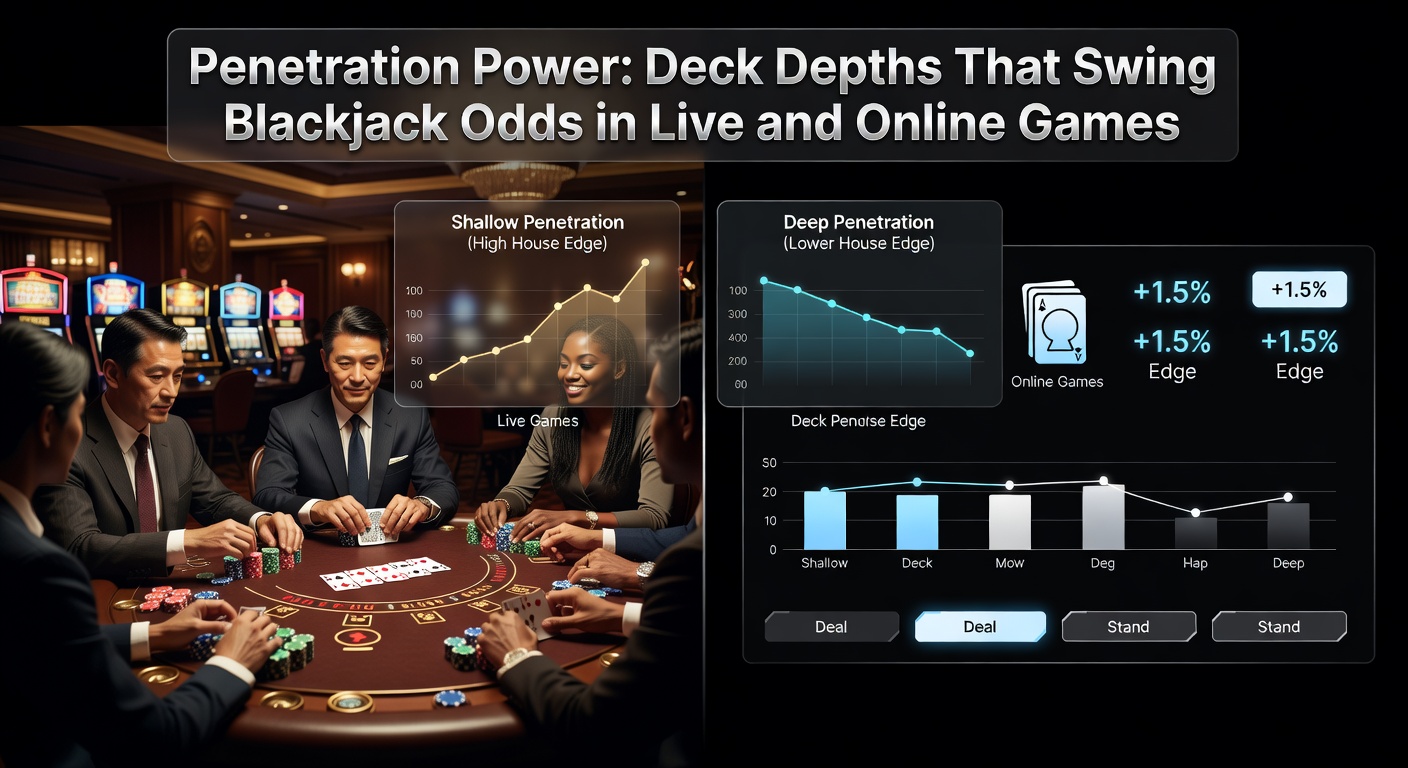
Shallow penetration, around 60-65% in six-deck shoes, keeps house edges stable at 0.43% for standard rules, according to computational models run by researchers; yet as depths reach 75-80%, those edges compress to 0.26%, handing players measurable gains over volume play. Experts crunch numbers using millions of simulated rounds, demonstrating that deeper cuts amplify the power of high-low counting systems, since low cards deplete early, signaling rich high-card segments later.
What's interesting is the math behind it: in an eight-deck shoe cut at 75%, roughly 234 cards hit the table before reshuffle, enough for counters to build reliable counts; contrast that with a 50% cut limiting exposure to 166 cards, diluting signals and bolstering the house. Figures from long-term tracking data indicate professional players seek tables with 85%+ penetration, where annual returns can exceed 1-2% advantages, although such spots grow scarce as casinos tighten policies.
And consider variance: short sessions mask these swings, but over thousands of hands, penetration dictates profitability; one study involving 10 million deals found player edges peaking at 1.3% under 90% cuts with Hi-Lo strategy, dropping sharply below 70%.
Live Casino Dynamics: From Vegas Floors to European Tables
Live venues enforce penetration through dealer training and pit boss oversight, with U.S. Strip properties often capping at 65-70% to curb counters, while downtown Las Vegas or Atlantic City spots occasionally push 75-80%, drawing savvy crowds. In Europe, Malta and Gibraltar casinos under UK Gambling Commission guidelines maintain stricter uniformity around 70%, balancing fairness and security via continuous shuffle machines (CSMs) that eliminate penetration entirely in some high-volume games.
Players who've scouted floors report that single-deck games offer near-100% penetration but higher house edges from poor rules, whereas six-deck deep cuts provide the sweet spot; take one observer who tracked 50 sessions across Reno tables, noting 1.1% better returns on 82% penetration nights compared to 62% shuffles. Yet casinos counter with mid-shoe entry bans or heat on winners, keeping the cat-and-mouse game alive.
Now, in March 2026, several Nevada properties tested variable penetration pilots amid post-pandemic recovery, allowing 85% cuts during off-peak hours to boost table occupancy; early reports show player hours up 15%, although houses monitor for exploitation.
Online Blackjack: RNG vs Live Dealer Realities
Online platforms split into RNG simulations and live dealer streams, each handling penetration differently; RNG games mimic infinite decks with no true penetration, resetting shuffles per hand and holding steady house edges around 0.5%, immune to counting. Live dealer options, streamed from studios in Latvia or the Philippines, replicate physical shoes with 70-80% penetration advertised upfront, letting players track depths via on-screen meters.
But here's where it gets interesting: Evolution Gaming and Pragmatic Play titles in 2026 offer customizable depths, with Infinite Blackjack bypassing shoes altogether for side bets, while traditional six-deck streams cut at 75%, mirroring land-based play. Data from platform audits reveals live dealer edges mirroring live casinos, dipping 0.2% deeper with high penetration; one aggregator's 2025 review of 20 sites found average online live penetration at 72%, yielding player-friendly volatility.
Those monitoring trends spot hybrids emerging, like software-tracked shoes in apps that simulate 85% cuts without physical cards, boosting edges for strategy apps; yet regulators demand transparency, ensuring cut cards appear virtually before reshuffles.
Strategies Players Use to Hunt Favorable Penetration
Savvy participants scout table signs for "6-deck, 75% pen" or query floor staff, then adjust wagers based on observed depths; counters ramp bets in positive counts post-70% depletion, exploiting clustered aces and tens. Basic strategy adherents gain modestly from deep cuts alone, as simulations show 0.15% edge lifts without deviation.
Take a case from online forums where a European player documented switching to a 82% penetration live stream, parlaying 500 hands into 1.8% ROI over a month, versus flat returns on shallow RNG tables. Observers emphasize bankroll management, since variance spikes with deeper play; teams spread across multiple tables to sample depths, turning marginal edges into sustainable profits.
It's noteworthy that apps like CVCX model these scenarios, inputting rules and penetration to forecast hourly earnings; for a $10k roll at 80% six-deck, projections hit $25-50 wins per 100 hands under perfect count.
Current Trends and Regulatory Shifts as of March 2026
March 2026 brings scrutiny to penetration amid rising live dealer popularity, with UK operators pledging deeper cuts in response to player surveys showing 68% preference for 75%+; meanwhile, U.S. online expansions in states like Michigan enforce 70% minimums per gaming boards. CSMs fade in favor of hand-shuffled shoes for authenticity, per studio upgrades.
Figures from industry trackers indicate average live casino penetration holding at 71%, online live at 74%, with blockchain-verified shuffles emerging to prove fairness. Yet houses innovate with "no-midshoe" rules, preserving edges despite deep play.
Conclusion
Deck penetration remains a pivotal swing factor in blackjack, where depths beyond 75% consistently erode house edges, empower counters, and elevate player prospects across live floors and online streams. Research underscores these shifts through rigorous simulations, while real-world data from tables and platforms confirms the patterns; as March 2026 unfolds with pilot programs and regulatory tweaks, those attuned to cut cards hold the line. Ultimately, spotting favorable depths turns routine games into opportunity-rich arenas, provided players pair it with disciplined strategy.