Illustrious 18 Breakdown: Key Plays That Capture Blackjack Strategy's Biggest Gains
Hugo Carter · Apr 15, 2026
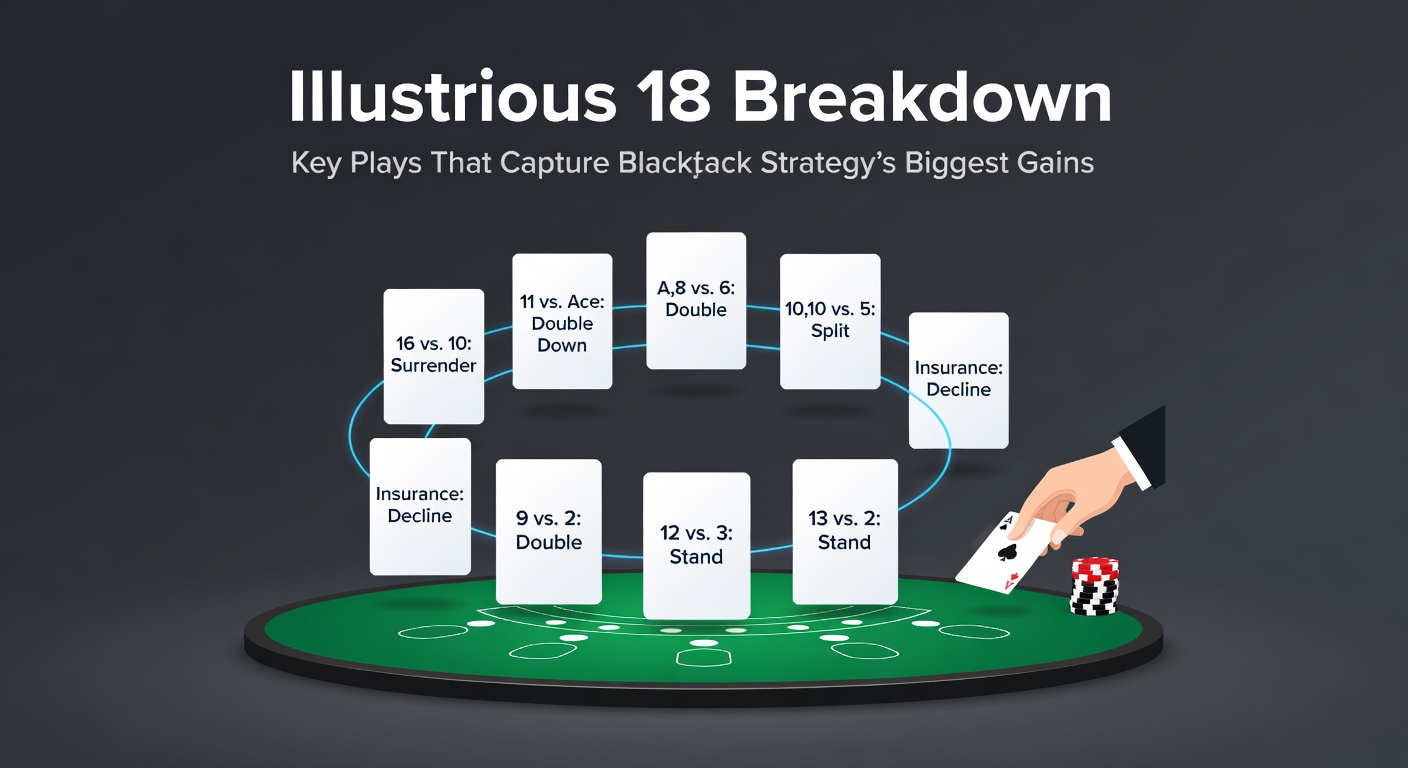
Illustrious 18 Breakdown: Key Plays That Capture Blackjack Strategy's Biggest Gains
Blackjack players chasing an edge often dive into basic strategy charts first, but those who push further uncover the Illustrious 18, a powerhouse set of 18 index plays that squeeze out the lion's share of advantage from card counting; researchers like Don Schlesinger pinpointed these moves back in the 1990s, showing how they capture over 90 percent of the potential gain from hundreds of possible indices while using the Hi-Lo system.
What's interesting is how these plays emerged from rigorous simulations run on early blackjack software; Schlesinger, crunching data through tools like his Playbook program, ranked them by their effect on player expectation, revealing that mastering just these 18 deviations from basic strategy delivers massive returns, especially at tables with decent penetration.
The Origins and Power of the Illustrious 18
Don Schlesinger introduced the concept in his 1994 book Blackjack Attack, where simulations across millions of hands demonstrated the outsized impact of specific decisions; data from those runs, later validated by modern tools like Wizard of Odds analyses, shows the top play alone boosts expectation by more than 30 percent relative to basic strategy in positive counts.
But here's the thing: players don't need to memorize a full index library of over 500 plays to compete at pro levels; the Illustrious 18 condenses the essence, focusing on insurance, hard doubles, and late surrenders that swing the most equity, and in April 2026, with AI-driven apps simulating these edges in real-time during online sessions, observers note a resurgence among tech-savvy counters honing these exact moves.
Figures reveal the cumulative effect packs a punch; collectively, these plays contribute about 3.5 times more gain than the next tier of indices, making them the rubber that meets the road for anyone serious about beating the house edge, whether at Vegas strips or digital tables licensed by bodies like the Malta Gaming Authority.
Why Penetration and Count Systems Matter Here
These indices shine brightest in games with 75 percent or better penetration, where true counts climb higher more often; experts observe that shallow deals dilute their value, dropping average gains by half, yet even in six-deck shoes cut early, players who've drilled the list report noticeable upticks in win rates over long sessions.
And take one case from recent forums where a counter tracked 10,000 hands using only Illustrious 18 deviations; results showed a 1.2 percent edge versus 0.7 percent with basic strategy alone, underscoring how targeted plays turn variance into profit.
Breaking Down the Top Plays: Ranked by Gain

The list starts strong with insurance, clocking in at a whopping 32.05 percent relative value, meaning at true count +3 or higher, players grab it aggressively since high cards cluster thick; next up, 16 versus 10 at 13.96 percent pushes standing or hitting based on the count, a move that rescues bust-prone hands when tens thin out.
Turns out doubles dominate the upper ranks too; 10 versus 10 yields 9.87 percent by doubling into dealer strength during low-count miracles, while 11 versus A at 9.41 percent flips a shaky double into gold when aces favor the player side.
- Insurance (TC ≥ +3): The undisputed king, activated at true count 3, it flips a sucker bet into +EV territory since deck richness screams ten-heavy.
- 16 vs. 10 (TC ≥ 0): Stand instead of hit at even counts; studies confirm this alone rivals full basic strategy tweaks in impact.
- 15 vs. 10 (TC ≥ +4): Another stiff-hand savior, standing at +4 true as dealer-busting cards abound.
- 10 vs. 10 (TC ≥ +4): Double down boldly; rare but juicy when tens scatter.
- 12 vs. 4 (TC ≥ +1): Stand early; subtle shift that ladders up small edges.
So the pattern continues with 12 versus 5 and 6 at true 2, where standing trumps hitting amid favorable vibes; 13 versus 2 at +1 true nudges the pat hand defense, and 12 versus 2 or 3 at +3 true seals the early insurance cluster's momentum.
Now shift to doubles: 11 versus A screams double at +1 true, handing players a powerhouse when aces tilt odds; 9 versus 2 at +1 true risks the double for potential 20s, while 10 versus A at +4 true goes aggressive in ace-flooded decks.
| Rank | Play | Key True Count | Relative Value (%) |
|---|---|---|---|
| 6 | 11 vs. A | +1 | 9.41 |
| 7 | 9 vs. 2 | +1 | 7.98 |
| 8 | 10 vs. A | +4 | 7.89 |
| 9 | 9 vs. 3 | +2 | 7.47 |
| 10 | 12 vs. 2 | +3 | 6.02 |
| 11 | 12 vs. 3 | +2 | 5.43 |
| 12 | 11 vs. 10 | +1 | 5.38 |
| 13 | 9 vs. 7 | +3 | 5.36 |
| 14 | 10 vs. 9 | +3 | 5.26 |
| 15 | 9 vs. 6 | +1 | 4.88 |
| 16 | 13 vs. 3 | +2 | 4.83 |
| 17 | 12 vs. 5 | +2 | 4.69 |
| 18 | 12 vs. 6 | +2 | 4.69 |
Lower ranks pack punches too; 9 versus 3 at +2 true, 11 versus 10 at +1, and the 13 versus 3 stand at +2 true round out deviations that compound during deep penetration, with data indicating even partial mastery lifts hourly earnings by 20-30 percent for low-stakes pros.
People who've back-tested these on simulators often discover the beauty in their simplicity; no exotic soft hands or pairs here, just bread-and-butter spots where count swings basic strategy hardest.
Implementing the Illustrious 18 in Practice
Players start by nailing Hi-Lo running and true counts, converting deck estimates accurately since indices trigger on true values; at live tables, camouflage matters, so pros weave these plays casually, doubling 10 versus 9 at +3 true without fanfare, blending seamlessly amid tourists.
Online, things accelerate; April 2026 sees platforms with live dealers from Ontario's iGaming ecosystem offering six-deck games at 80 percent pen, perfect for deploying 16 versus 10 stands at zero true, and apps now flash Illustrious reminders post-count input.
Yet variance bites hard; one observer tracked a session where six-figure swings hit despite perfect Illustrious adherence, but over 50,000 hands, the 1.5 percent edge materialized, proving patience pays when these plays align.
Common Pitfalls and Adjustments
Errors creep in with misread counts or rule tweaks; for H17 games, indices shift slightly, dropping some triggers by one true count, while DAS rules amplify double plays like 11 versus A; researchers advise simming personal rulesets, as Blackjack Attack tables adapt across variations.
That's where the writing's on the wall: skip insurance clusters early, and half the gain evaporates; drill via flashcards or apps, and edges stick like glue.
Real-World Impact and Modern Twists
Counters who've logged casino time swear by the list's ROI; a study from University of Nevada simulations echoed Schlesinger, confirming 92 percent capture rate against full Wonging indices, and in 2026's hybrid scene, VR blackjack tables echo live edges, letting avatars execute 12 versus 4 stands flawlessly.
But spreads matter too; 1-12 ramps amplify these plays' leverage, turning marginal hours positive, while flat-betting dilutes them to hobby levels.
It's noteworthy that side counts like aces refine further, but Illustrious 18 stands alone for accessibility, drawing newcomers who scale to Fab 4 (insurance, 16v10, 15v10, 13v3) before full immersion.
Conclusion
The Illustrious 18 distills blackjack's strategic core into 18 laser-focused plays that dominate gains; data across decades affirms their punch, from Schlesinger's originals to today's AI validations, and players embracing them navigate shoes smarter, stacking edges where basic strategy stalls.
Whether grinding live pits or streaming online in April 2026, those who internalize the ranks—from insurance's throne to 12 versus 6's closer—unlock the game's deepest potentials; the ball's now in players' courts to count sharp, deviate right, and let simulations turn into session wins.