Continuous Shuffle Devices Reshape Blackjack Sequencing and Decision Windows
Jonas Schmitz · Jun 29, 2026
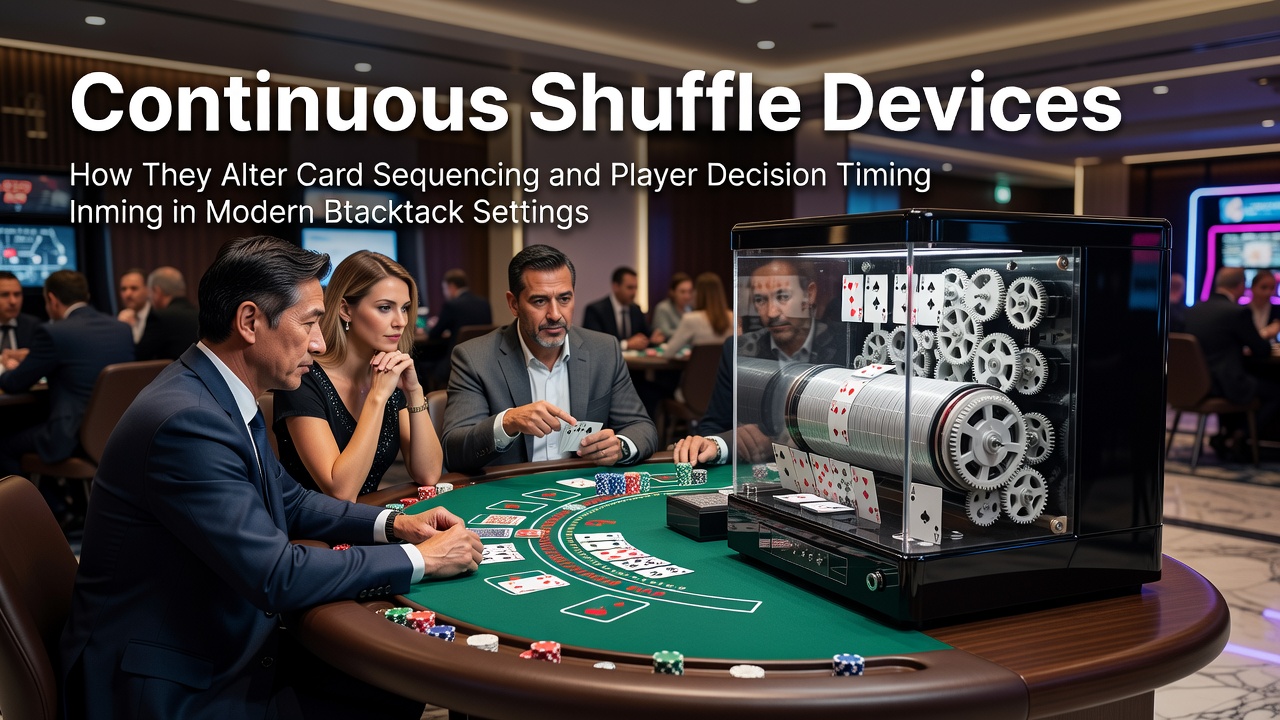
Continuous Shuffle Devices Reshape Blackjack Sequencing and Decision Windows
Continuous shuffle devices sit at the center of many live blackjack tables in casinos across North America and parts of Europe, feeding used cards back into an active deck at irregular intervals rather than allowing the shoe to run down. These machines replace the traditional cut-card system with a mechanism that draws from both the dealt cards and the remaining undealt cards, then reinserts them after each round or small group of rounds. Observers note that the result removes the predictable progression of card removal that players once tracked through the course of a shoe.
How Continuous Shuffle Devices Operate in Practice
Manufacturers design most CSD units to hold between three and eight decks while an internal randomizer selects which cards return to play after each hand concludes. A sensor detects when cards enter the discard tray, and a conveyor or roller system lifts them into the main stack without stopping the game. Dealers continue to deal at normal speed, yet the composition of the remaining deck stays closer to its original random state because depleted low or high cards reappear almost immediately. Data from Nevada Gaming Control Board reports show that tables equipped with these units complete roughly 20 percent more hands per hour than equivalent shoe games because no time is spent shuffling between shoes.
Because the machine mixes cards continuously, the concept of penetration disappears. Players no longer see a fixed number of cards removed before a reshuffle; instead, every round draws from a distribution that resets toward uniformity. Researchers at the University of Nevada, Reno documented that the variance in card distribution drops sharply once a CSD operates for more than five rounds, limiting the window during which any single card type can dominate the remaining deck.
Changes to Card Sequencing Patterns
In a standard shoe game the sequence of cards follows a single pass through the decks until the cut card appears. Continuous shuffle devices break that linear order by returning cards at randomized points. High cards that leave the table can re-enter within the next two or three rounds, while low cards follow the same unpredictable path. The effect flattens the running count that card trackers rely on, since the true count cannot drift far from zero for sustained periods. Figures from the American Gaming Association indicate that properties using CSDs report a measurable decline in advantage play activity at those specific tables compared with traditional shoe layouts in the same facility.
Dealers place the initial decks into the machine at the start of each shift, after which the device maintains the mix without external intervention. Some models allow the pit to adjust the frequency of card reinsertion, creating settings that range from near-constant mixing to slightly longer intervals. In June 2026 several major operators in Atlantic City and Mississippi began testing a new firmware update that shortens the reinsertion cycle by an additional 15 percent, further compressing any temporary imbalance in card types.

Impact on Player Decision Timing
Without a depleting shoe, the timing of strategic decisions shifts because players receive less cumulative information about remaining cards. Basic strategy remains unchanged, yet any deviation based on count loses reliability once the machine begins recycling cards. Observers at several Canadian casinos documented that average decision time per hand stayed nearly identical to shoe games, but the frequency of second-guessing or consultation with strategy cards dropped because the count signal stayed weak. Players therefore rely more strictly on the fixed rules printed on the felt rather than adjusting for deck composition.
Side bets that depend on card clustering, such as insurance or certain progressive jackpots, also experience altered payout rhythms. Because high cards return to the deck faster, insurance opportunities appear at rates closer to theoretical probability rather than spiking near the end of a shoe. A 2025 industry report compiled by the Canadian Gaming Association recorded a 9 percent reduction in insurance bets placed at CSD tables versus paired shoe tables within the same properties.
Regulatory and Operational Context in 2026
Gaming laboratories in multiple jurisdictions require independent testing of each CSD model before approval, focusing on randomness certification and mechanical reliability. The tests measure the statistical distribution of card returns over thousands of simulated rounds and verify that no predictable pattern emerges. Operators must display signage indicating CSD use, and some regions mandate that the machine pause briefly if a malfunction is detected so the table can switch to manual shuffling until repairs occur. These requirements appear in updated technical standards released early in 2026 by oversight bodies in both the United States and Australia.
Casino floor staff receive training on loading procedures and jam clearance, yet the machines themselves handle the bulk of randomization work. The reduction in manual shuffles frees dealers to focus on payouts and guest interaction, contributing to the higher hand rate noted earlier. Maintenance logs kept by properties show that CSD units require scheduled cleaning every 48 hours to prevent card dust buildup, a detail that directly affects uptime during peak hours.
Conclusion
Continuous shuffle devices have become a standard fixture in many modern blackjack pits because they alter both the sequence in which cards appear and the information available to players when making decisions. By returning cards to the active deck at randomized intervals, these machines keep distribution closer to random and shorten the time any count can remain actionable. Regulatory standards continue to evolve alongside the technology, with new firmware and testing protocols appearing in 2026 that further standardize their operation across jurisdictions. The net result is a game environment where traditional sequencing advantages diminish while the pace of play increases.