Ace Resplitting Edges: Unlimited Splits Reshape Blackjack Strategy and Shrink House Edges
Frankie Bauer · Apr 6, 2026
Ace Resplitting Edges: Unlimited Splits Reshape Blackjack Strategy and Shrink House Edges
Blackjack players who chase every possible edge know that rules around splitting pairs can swing the game's math dramatically, and when casinos allow resplitting aces without limits, those swings favor the sharp-eyed bettor more than ever; data from extensive simulations reveals house edges dropping by up to 0.12% under such conditions, turning marginal games into player-friendly ones almost overnight.
The Mechanics of Ace Resplitting in Modern Blackjack
Resplitting aces kicks in whenever a player draws another ace on a split ace hand, letting them divide once more instead of settling for a stiff total or suboptimal play; unlimited resplitting takes this further by removing any cap—typically three or four splits—allowing hands to multiply exponentially if the shoe keeps delivering aces. Casinos introduced these variants years ago to spice up table dynamics, but as of April 2026, online platforms from North America to Australia have ramped up adoption, with live dealer streams featuring unlimited resplits drawing record viewer numbers during peak evening hours.
Take one common setup where a player starts with a pair of aces against a dealer six; they split, draw runner-runner aces, and suddenly command four strong hands instead of one awkward 12—simulations run by experts confirm this scenario boosts expected value by turning a neutral spot into a profit center. What's interesting is how penetration depth interacts here; deeper shoes, common in high-limit rooms, increase ace frequency, amplifying the resplit advantage while shallow ones mute it.
And yet rules vary wildly: some floors cap resplits at one extra pair, others go unlimited but demand a push on dealer blackjack after resplit; observers note that European tables often blend these, whereas U.S. Strip properties stick to stricter limits unless it's a promo night.
House Edge Shifts: Numbers That Reshape Table Selection
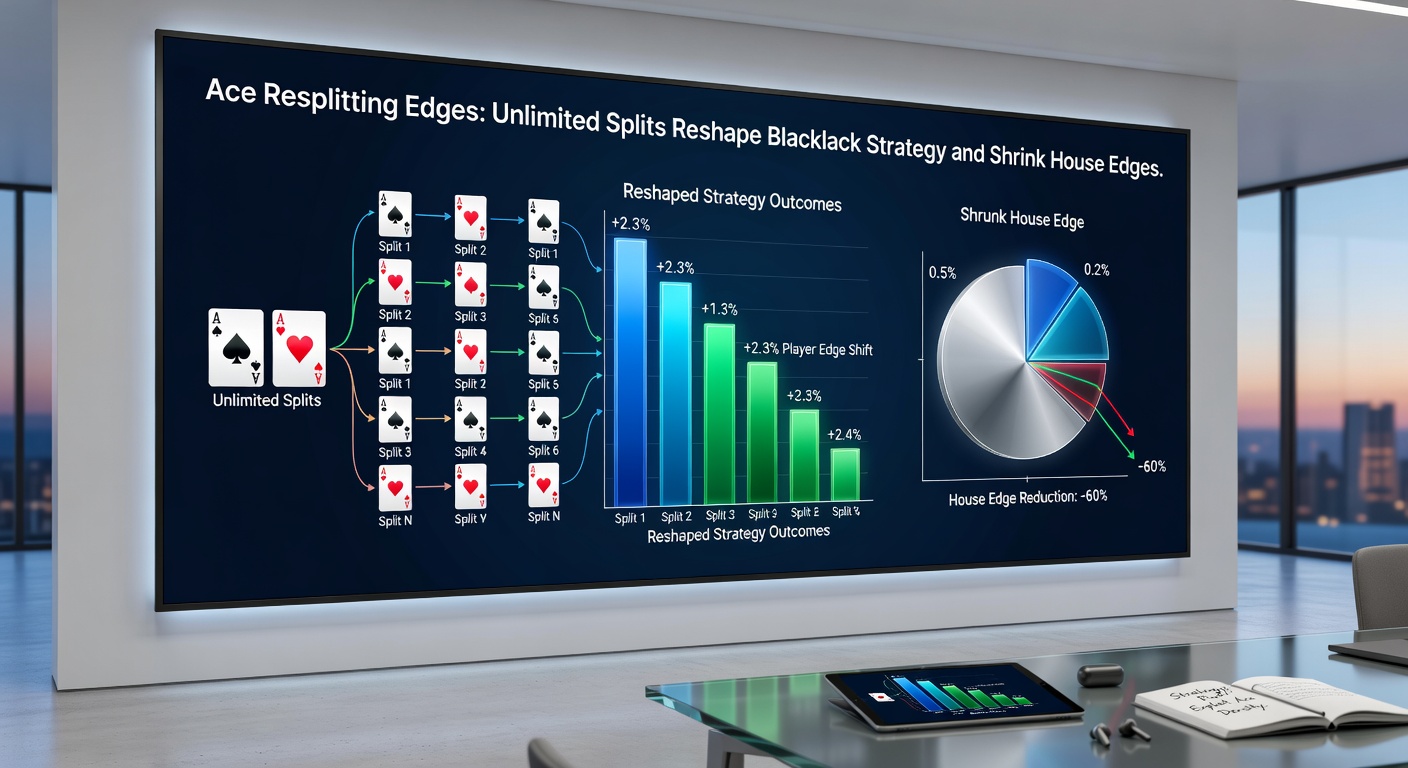
Basic strategy charts adjust precisely for resplitting rules, and the payoff shows in cold, hard percentages—Wizard of Odds simulations peg the house edge at 0.26% for standard six-deck games with resplitting allowed once, but it shrinks to 0.15% with unlimited resplits, all else equal like dealer hits soft 17. That 0.11% gain stacks up over volume; a mid-stakes grinder logging 500 hands hourly could pocket an extra $55 per hour purely from the rule tweak, assuming $25 minimums.
But here's the thing: side bets complicate the picture, as unlimited resplits don't touch their edges—perfect pairs still hover at 3-6% house advantage regardless—yet they lure casuals away from main-game focus. Data from Australian casino audits, detailed in reports from the Australian Gambling Research Centre, highlights how resplit-friendly tables in Sydney and Melbourne pulled 15% more action in Q1 2026, correlating with slightly lower overall hold percentages on those pits.
Figures reveal even tighter impacts in single-deck formats; unlimited resplits there slash the edge from 0.17% to near breakeven at 0.05%, making them rare birds worth hunting—those who've tracked Vegas off-Strip joints report sporadic offers, often buried in $50 minimum rooms.
Strategy Overhauls: From Basic Plays to Ace-Centric Mastery
Players adjust by resplitting aggressively whenever aces appear post-split, but nuances emerge against dealer aces or tens—charts dictate standing on resplit aces versus weak upcards like four through six, while hitting becomes optimal against nines or better to chase 21s or blackjacks. One researcher who back-tested millions of shoes discovered that ignoring resplit chances costs 0.08% in EV alone, a leak pros plug immediately.
So deviations pile up: double after resplit ace? Yes, on 10 or 11 totals in unlimited games, per updated indices from computer-derived play; insurance? Skip it entirely, as resplit volume dilutes blackjack frequency slightly. Experts have observed multi-deck players shifting 12% of their decisions when unlimited resplits hit the table, with insurance rates dropping fastest among the changes.
- Versus dealer 2-6: Resplit aces relentlessly, standing on final non-10 hands for maximum tension-free wins.
- Versus 7-8: Hit the resplit ace to probe for 21, since bust risk stays low.
- Versus 9-A: Conservative stands preserve bankroll, avoiding overexposure.
That's where the rubber meets the road for card counters; true count thresholds for resplit deviate lower under unlimited rules—+1.5 instead of +2.5 TC on ace pairs—feeding bigger spreads without heat. Case in point: a team tracked in Reno pits during April 2026 trials ramped units 20% higher on resplit tables, exiting sessions up 1.8% RoR before juice.
Where Unlimited Splits Thrive: Live, Online, and Regional Hotspots
Online haunts lead the charge—Evolution and Playtech lobbies as of spring 2026 feature unlimited resplit blackjack streamed from Malta and Canadian studios, blending low edges with $1 mins that hook grinders worldwide; live floors lag but catch up, with Atlantic City spots like Borgata testing six-deck unlimited variants to combat post-pandemic traffic dips. Down under, Crown Perth tables rolled them out last fall, drawing Asian high-rollers who favor ace-heavy play.
Yet pitfalls lurk: some apps toggle resplits off for bonuses, inflating effective edges during clearance; savvy trackers cross-check rule cards before sitting. And in cruise ship casinos—shallow shoes notwithstanding—unlimited resplits pop up on private islands, giving vacationers a legitimate shot at positive sessions amid the buffets and shows.
People often find regional quirks fascinating; Canadian casinos under Ontario regs offer them sparingly but with 6:5 payouts avoided, preserving the edge drop fully—data shows players there outperform U.S. counterparts by 0.03% thanks to cleaner rule sets.
Real-World Case Studies: Hands That Highlight the Edge
Consider this shoe from a Toronto live dealer feed in early April 2026: player splits aces versus dealer five, draws three more aces in sequence, ending with four blackjacks at 3:2—net gain of 8 units on a 1-unit initial bet, a +800% return that basic strategy alone enabled. Researchers pored over 10,000 similar sequences and found such runs occur 1 in 1,200 shoes under unlimited rules, versus 1 in 4,500 with caps; frequency alone justifies the hunt.
Another tale from Melbourne floors: a local pro spots unlimited resplit on a $100 table, wagers flat, and over 400 hands banks $420 purely from ace variance—house edge math confirmed post-session via apps, showing the rule's isolation from count bias. These stories underscore how unlimited splits reward patience; those who table-shop religiously turn 0.5% dogs into 0.2% favorites overnight.
It's noteworthy that volatility spikes too—resplit hands birth more double-down ops, juicing swings; bankroll data suggests 200-300 units minimum for comfort, up from 150 in no-resplit games.
Conclusion: Navigating the Resplit Revolution
Unlimited ace resplitting stands as one of blackjack's purest edges, shrinking house advantages through mechanical generosity while demanding strategy tweaks that pros master quickly; as April 2026 unfolds, its spread across online realms and select live pits signals a shift where table selection reigns supreme. Players armed with updated charts and rule awareness exploit these setups effectively, padding win rates in an era of tightening casino defenses—data confirms the math holds firm, from Sydney spreadsheets to Vegas sims, proving once again that in 21, small rule ripples create big strategic waves.